


An international early childhood education program helps Ottawa-area families build confidence, connections and early bonds
Editor’s Note: This story was a part of the series You can do it, which ran in the Spring 2026 issue.
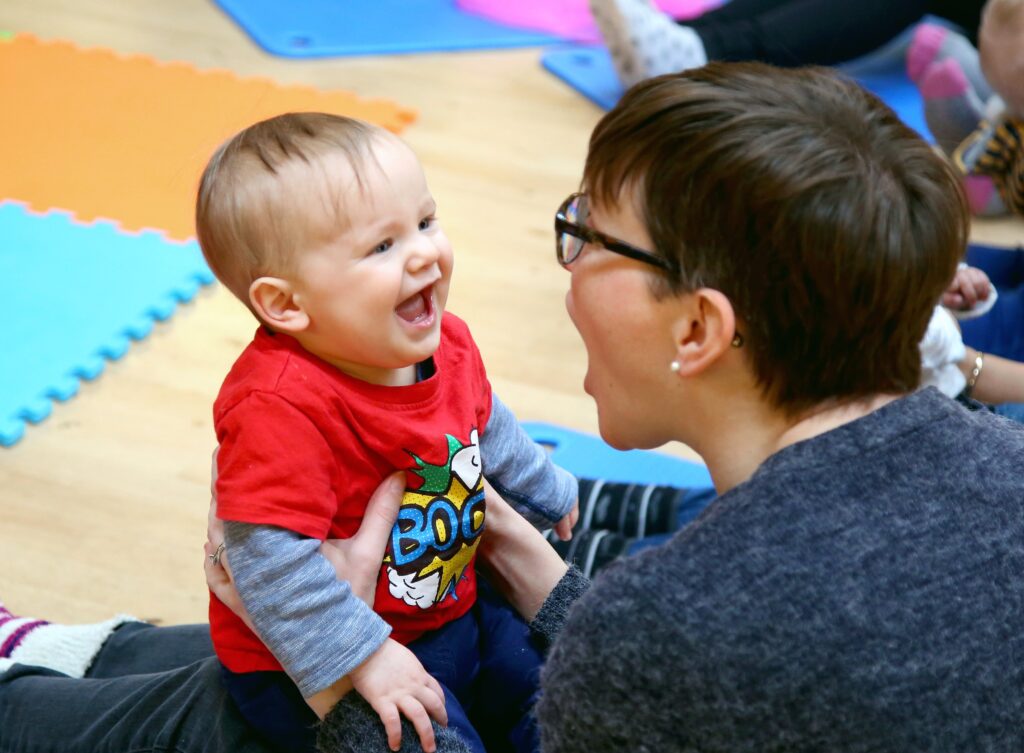
A parent and baby learn together at Baby College. Photo Courtesy Baby College UK
As the saying goes, kids grow up fast. But college… for babies?
Absolutely, says Katrina Morrison, an instructor and franchise owner of Baby College, an international early childhood program with roots in Oxford, U.K., with Ontario locations in Ottawa, Nepean, Kanata, Orleans, Almonte, Carleton Place and Renfrew.
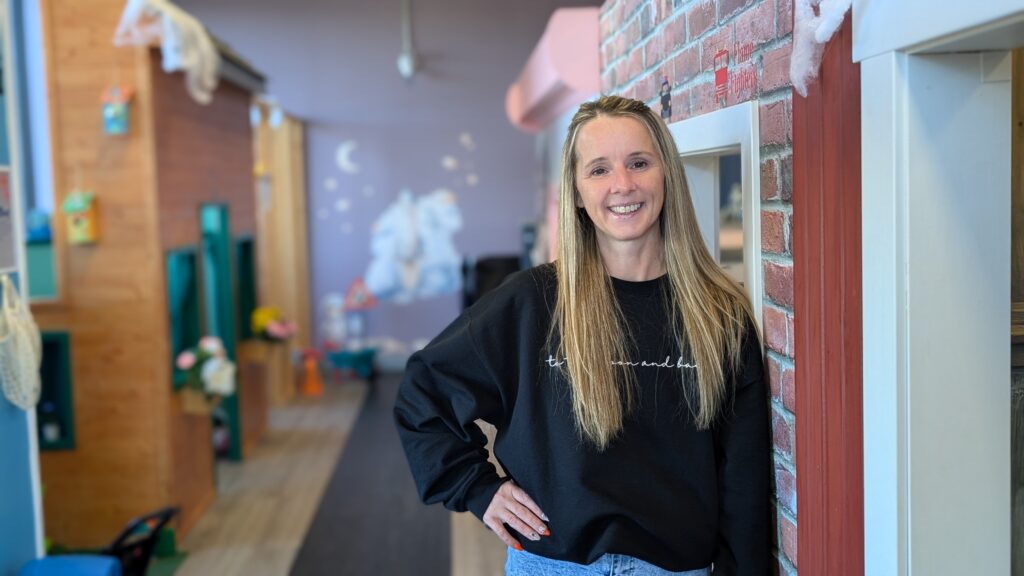
Katrina Morrison. Photo Credit Amy Hogue at Dragonfly Communications
“Some families join us with babies just a few weeks old,” says Morrison. “Our youngest baby was just two weeks old when they started.”
The first few years of life are a critical period for brain development, says Morrison. “Babies are learning and absorbing information at an incredible rate.”
Programs like Baby College support this development by encouraging language development through music and baby sign language; social skills through interaction with others; physical development through movement, dance and play and cognitive development through sensory exploration.
Just as importantly, the program helps parents understand how everyday interactions can support their baby’s growth.
But what sets Baby College apart from other baby classes is its roots in science, says Morrison, who completed specialized training through the program to ensure that the classes are delivered according to its research-based curriculum.
“The program is research-based and structured around child development, rather than simply being a playgroup,” she says. “Each class combines fun activities with insights into how babies learn and grow.”

An infant enjoys sensory play (bubbles) at Baby College. Photo Courtesy Baby College UK
Baby College comes to Canada
A mother of four girls – Chloe, 26, Cerys, 22, Kyla, 13 and Kelsey, 8 and grandmother of one – Morrison heard about Baby College UK when her fourth daughter was born.
“What impressed me most was how the program combines science-based child development with fun, engaging activities,” says Morrison. “Parents are not just entertaining their babies — they’re learning meaningful ways to support their child’s development.”
After approaching Baby College UK to inquire whether they had classes in Canada – and learning that they didn’t – Morrison opened the first Baby College franchise in Canada.
Locations that accommodate families
Rather than operating out of one permanent brick-and-mortar location, classes are typically held in community halls, family centres, and other welcoming spaces that are convenient for local families. This approach allows the program to reach more communities and keep classes accessible for parents across the region.
Classes typically run once per week over four or five weeks, which gives families regular opportunities to connect, learn new activities, and practice developmental skills. Weekly sessions also allow babies to become familiar with the environment and build routines and graduation is marked with a ceremony, graduation caps, a red carpet and certificates.
“Many families attend consistently throughout the early years because each stage of development introduces new activities and learning opportunities,” says Morrison.
After graduation from the final program, families often move on to preschool programs, community playgroups, or early learning classes that continue to support social and developmental growth.
Munster resident Sharon Lyng enrolled both her sons in multiple sessions of Baby College in Kanata and Almonte.
As a first-time mom, Lyng joined Baby College in 2022 with her older son, Darcy, to get out of the house, meet other moms and to learn new ways to teach her baby.
They got more out it than she’d imagined.
“Both my kiddos [gained] confidence in skill building around play, movement, focus, attention, social play, gross motor and fine motor skills. Darcy even took his first steps at Baby College! It was a very special memory.”
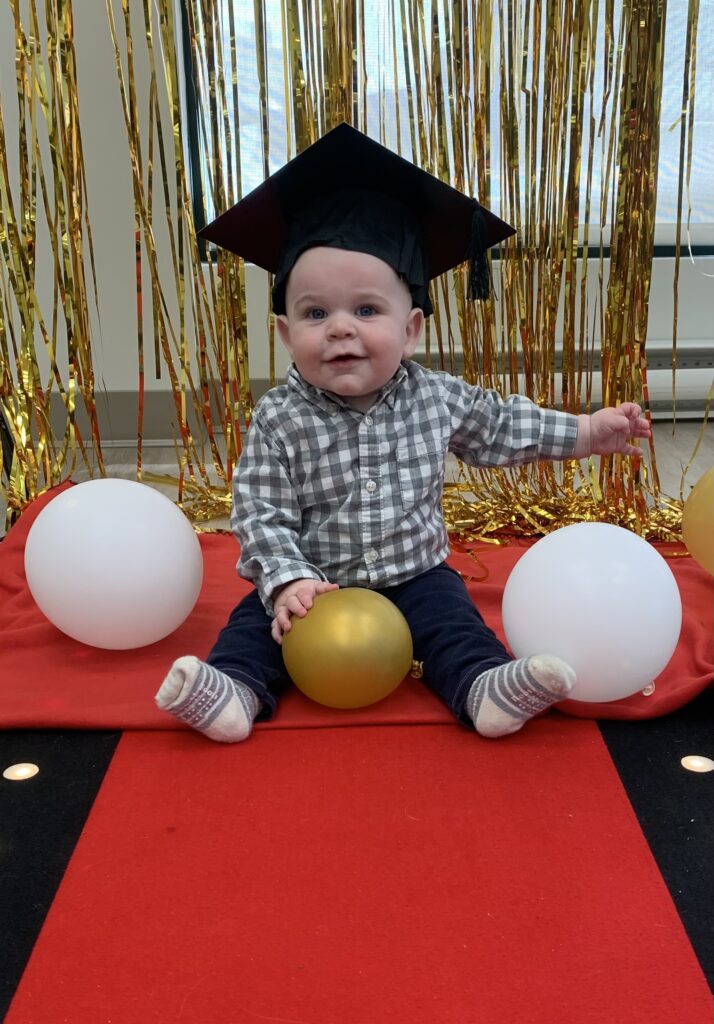
Sharon Lyng’s son Darcy graduated from the Infant program at Baby College in March 2023. Photo Credit Sharon Lyng
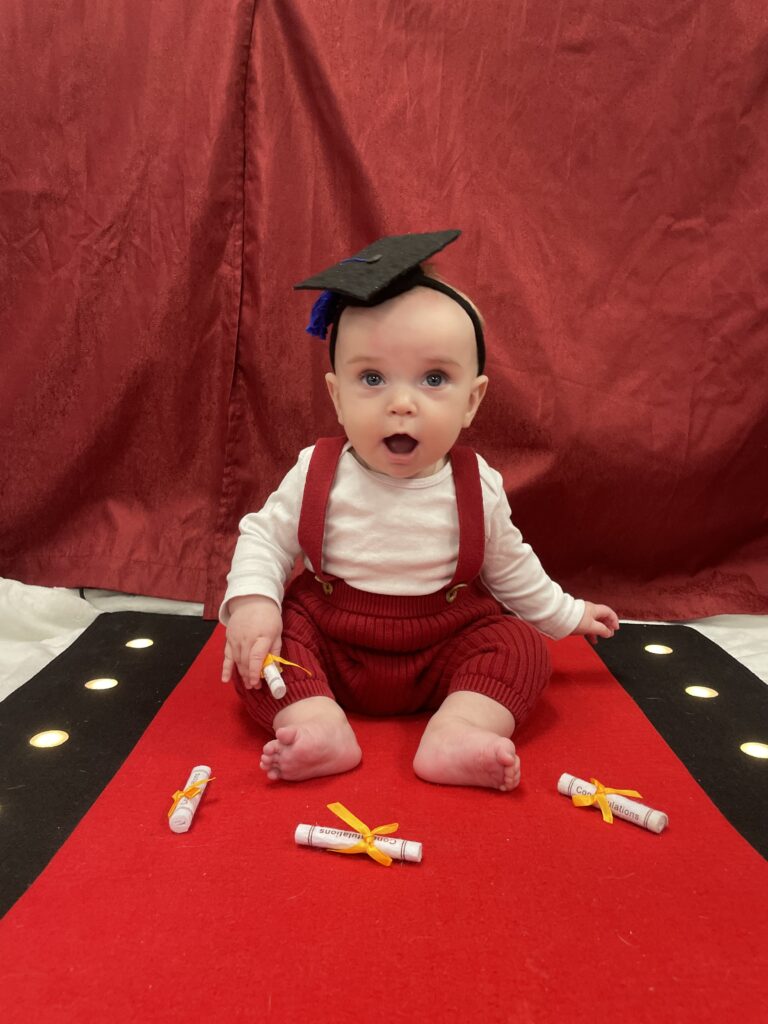
Sharon Lyng’s son Charlie graduated from the Infant program at Baby College in February 2025. Photo Credit Sharon Lyng
Darcy is now 3.5 and Charlie is 1.5. “I loved every time joining in on Baby College with my sons,” says Lyng. “It was a time that [my sons and I] could spend time together while having fun. There were no other life distractions and I could focus all my attention on building skills with my kids.”
The biggest impact Morrison has seen is often confidence — both in parents and children, she says. “Parents feel more comfortable engaging with their babies and understanding their development, while children benefit from social interaction, stimulation and fun learning experiences.”
Baby College for parents
Morrison has been to her share of baby classes in both her native Scotland and in Canada. She likes Baby College because parents are not just accompanying their children and observing. They are participating in activities and learning how and why these activities are supporting their child’s development, while receiving advice on how to continue the learning at home.
Morrison also sees parents supporting each other and making friends during what is sometimes an isolating time. “Having experienced the early years of parenting myself, I understand how rewarding but also challenging that stage of life can be,” she says.
“Some sessions we would sign up with other mom and baby friends,” says Lyng, “but we also signed up not knowing anyone and we made new lifelong friends. It was also a great opportunity to talk about struggles that may be presenting where other parents shared advice or tips and tricks they have used.”
This is one of the considerations for parents and guardians when signing up, Morrison says.
“Many parents tell me they’re looking for connection with other families, but it can sometimes feel intimidating to walk into a room and feel like you have to immediately socialize,” says Morrison. “One thing that parents really appreciate about Baby College is that the classes are instructor-led, so families don’t feel pressure to ‘put themselves out there’ right away. Everyone can simply focus on enjoying the activities with their baby.”
At the end of each class, there is a short social time, which gives parents the opportunity to chat if they wish. “Over time, many friendships form within the group,” says Morrison. “In the end, the sense of community and connection is a big part of what makes these classes special.”
-30-
Which Baby College class is right for your family?
Infants (0 to 9 months)
Infant classes offer an insight into baby development to increase parent confidence and understanding of a growing baby. All activities are suitable from birth with the exercises progressing as a baby grows.
Toddlers (9 to 18 months)
Toddler classes introduce additional learning themes and new skills to active, curious babies. Activities promote language and social skills and body awareness.
Juniors (18 months to 3 years)
The Junior program encourages confidence in physical and social skills and supports increased independence with fun and stimulating games.
Baby Massage (0 to 6 months)
Instructors teach full-body baby massage accompanied by songs and movements. Classes include discussion topics to support parents and babies and relaxation and stretches for parents.
Did you know?
Ottawa Baby College has a link with Ashbury College. Baby College founder Bea Waterfield’s grandfather Arthur Amyand Victor Waterfield (John) was a teacher at Ashbury College shortly before the Second World War.